AI Myths in Design, Debunked: What AI Can Do, What It Can't, and Where Humans Still Win
Every week a new AI tool promises to replace designers, and every week someone asks us whether they still need one. Most AI myths in design are half true, which makes them more confusing than a plain lie.
Here are the six we hear most, what the evidence says, and a simple way to split the work so AI and people each do what they do best.
Key takeaways
• AI replaces design tasks, not design judgment.
• In the US, a prompt alone does not make you the author. Human edits, selection and arrangement can be protected.
• AI can check rules like contrast. It cannot tell you how a real person feels using your product.
• Best split: AI for volume and repetition, people for the brief, the choice and the final call.
Myth: AI will replace designers. Reality: it replaces tasks, not judgment
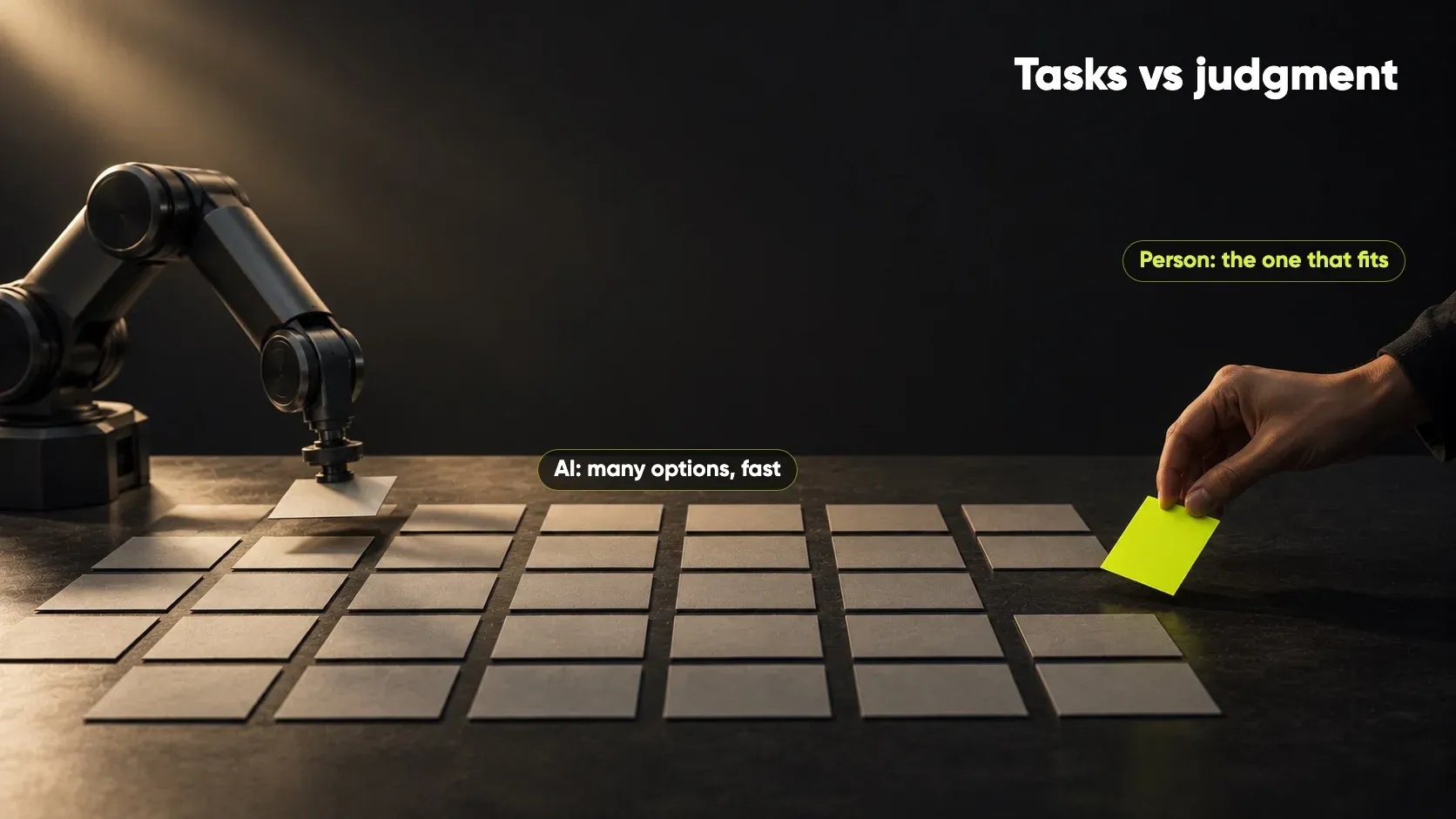
AI can produce a logo idea in seconds. It cannot sit with your team, notice the concern nobody says out loud, and turn a vague goal into a direction everyone can defend.
The repetitive parts (resizing, background removal, first-pass variations) are where AI shines. Handing them over frees people for the decisions that make the work succeed.
Myth: AI designs are original. Reality: they remix patterns, and can echo existing work
Image generators learn patterns from huge sets of existing images and recombine them. The result can look fresh, but it can also land close to someone else's work.
That matters most for logos. Treat an AI mark as a sketch: have a designer redraw it, and check it against existing marks in your market.
Myth: you own whatever AI makes. Reality: in the US, prompts alone don't make you the author
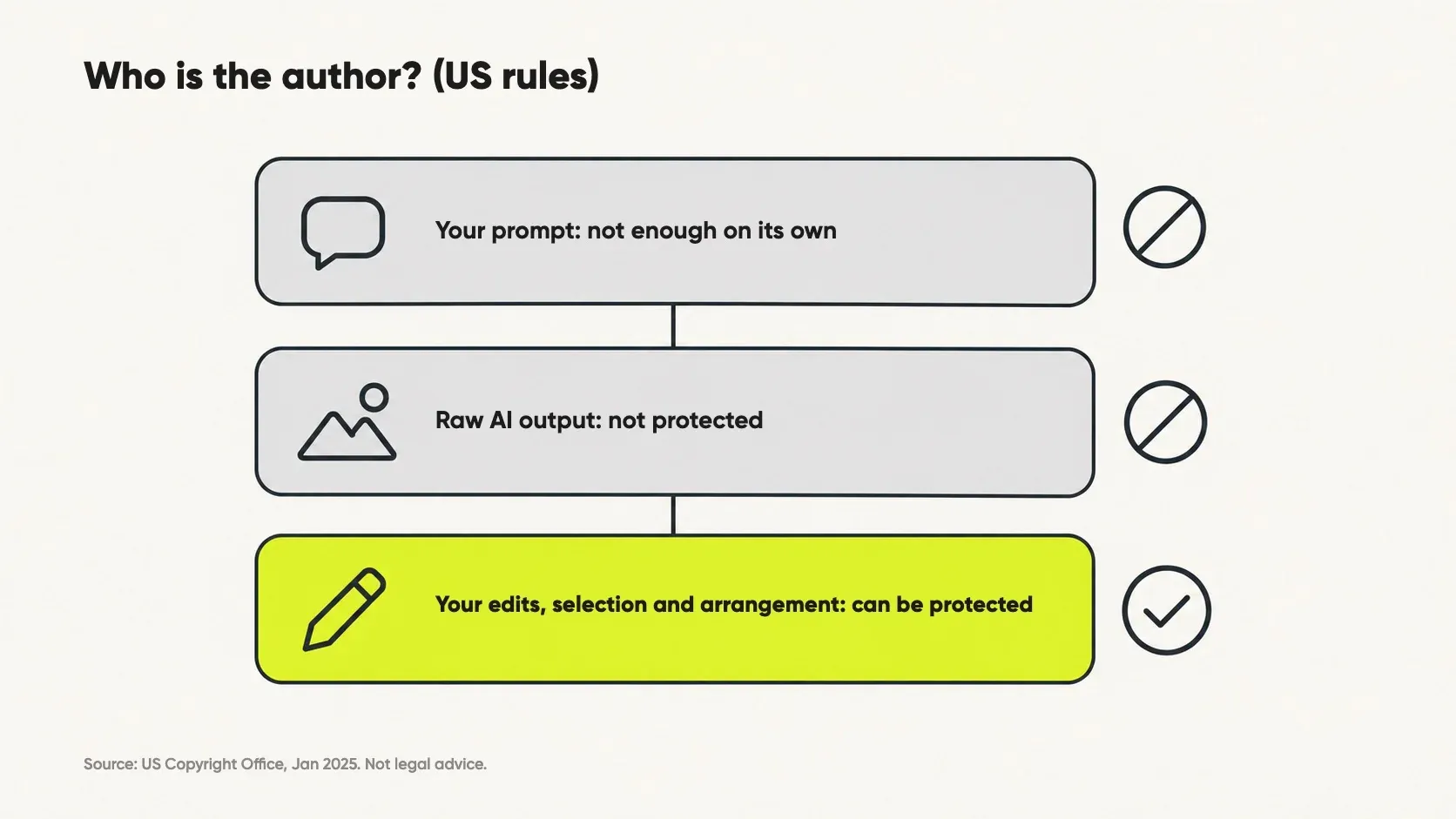
In its January 2025 report on copyrightability, the US Copyright Office concluded that AI output is protected only where a human has determined enough of the expressive elements. Writing prompts is not enough. Your own work visible in the output, your creative changes, and how you select and arrange material can be protected.
The courts agree. In Thaler v. Perlmutter (March 2025), a federal appeals court held that copyright requires a human author, and the Supreme Court declined to hear the appeal in March 2026. If you register a work containing AI material, the Office's registration guidance asks you to disclose it and describe the human part.
What to do: have a designer develop anything AI starts, keep the working files, and read your AI tool's terms. This is US guidance, not legal advice; other countries differ, and trademarks are a separate question for an IP lawyer.
Myth: anyone can get great design from AI. Reality: output is only as good as the brief and the eye
Type "make me a modern website" and you get something generic, because the request was generic. Good results depend on knowing what to ask for and spotting what is wrong.
AI makes production cheaper, not taste. Our guide on how to write a brand brief works for people and prompts alike.
Myth: AI takes care of UX and accessibility. Reality: tools check rules, not experience
Automated tools can check whether body text meets the WCAG 4.5:1 contrast minimum. But the W3C says evaluation tools cannot determine accessibility on their own; human judgment is required.
A checker cannot tell you whether a screen reader user can finish your checkout. That takes watching real people. Our 10 UX design principles cover what to look for.
Myth: AI keeps everything on-brand. Reality: it follows the rules, not the spirit
AI can apply your colors and fonts. It struggles with why your brand sounds playful at a launch but calm in a support email. And because it learns from what already worked, it is better at fitting in than standing out.
Guidelines say what is allowed. Someone who knows the brand decides what is right for this moment.
Who does what: a simple split for AI and people
| Task | Let AI do it | Keep a human on it |
|---|---|---|
| Early ideas | Quick variations and mood directions | Choosing the direction that fits the strategy |
| Production | Resizing, background removal, exports | Final quality check before launch |
| Imagery | Textures, extended backgrounds, mockups | Logos and key brand assets |
| Accessibility | Automated contrast and spec checks | Testing with real people |
| Copy and layout | First drafts and alternatives | Tone, hierarchy and what gets cut |
How to run a design project with AI and people together
Keep a person at each decision point and let AI fill the gaps between them.
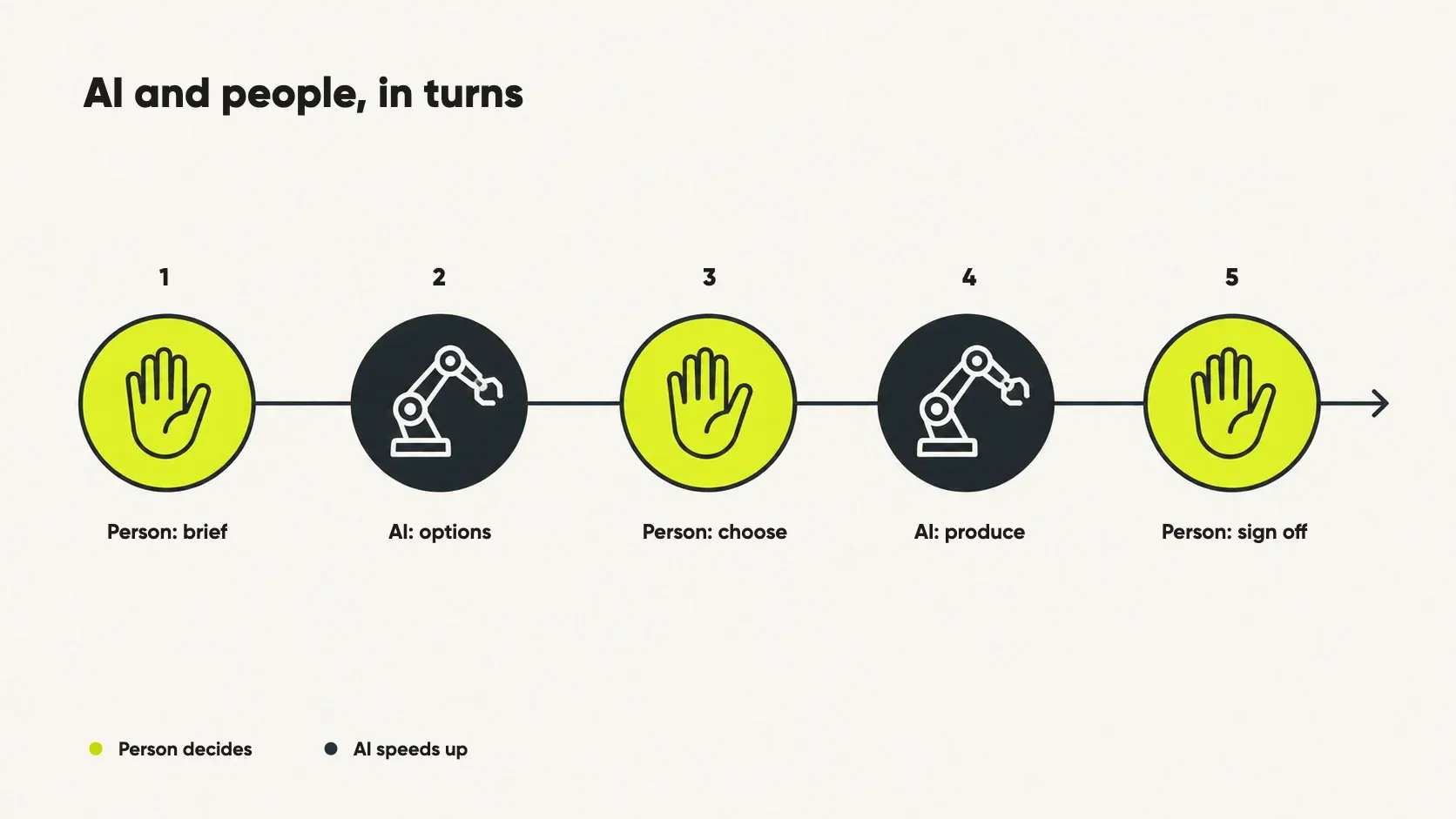
- A person writes the brief: audience, goal, limits.
- AI widens the options: variations, references, rough directions.
- A person narrows them: one direction, and why.
- AI speeds up production: variants, sizes, mockups.
- A person signs off: brand fit, accessibility, legal checks.
More on this way of working: why the best creative work needs both AI and people.
Where humans still win
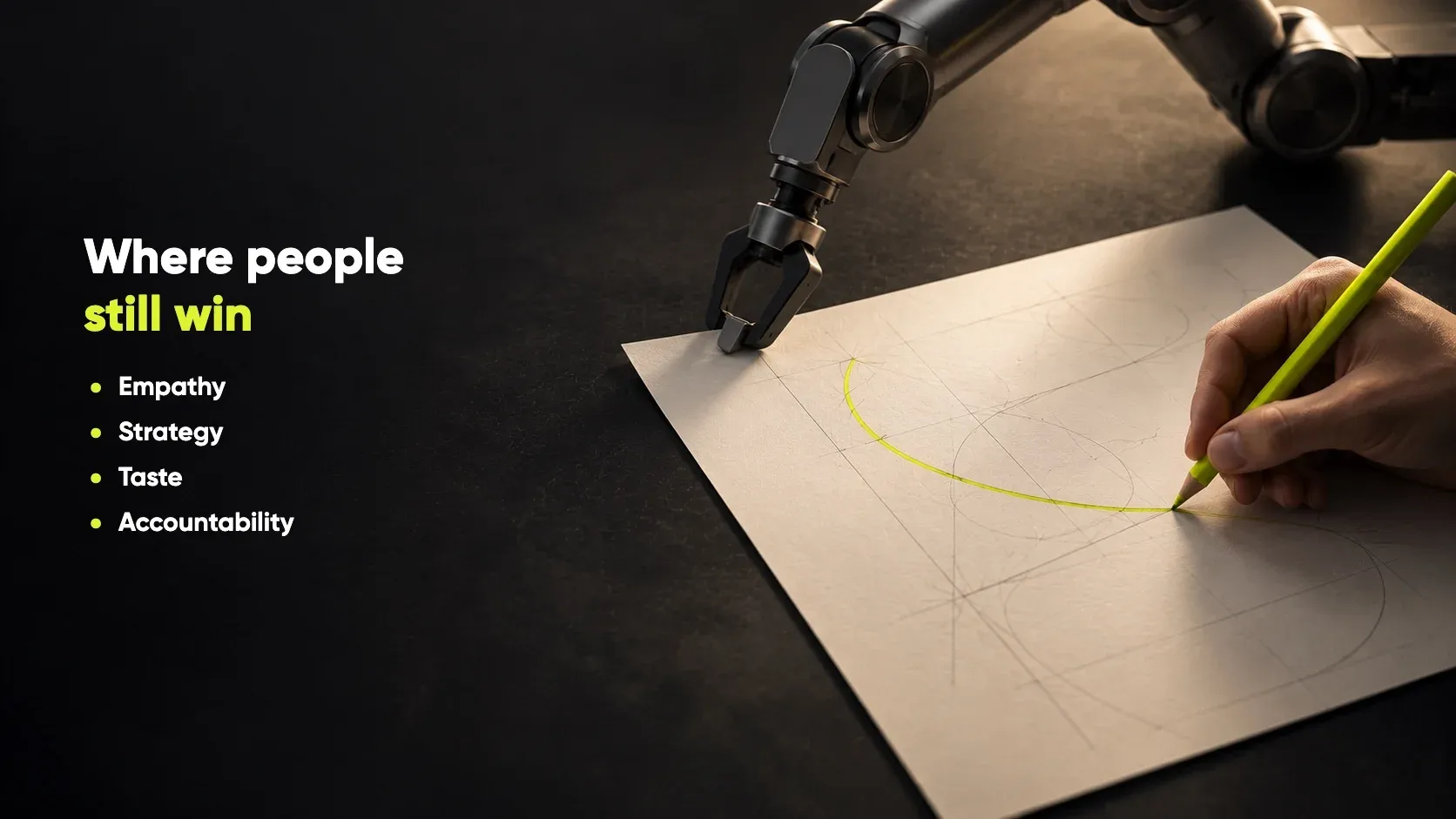
- Empathy: reading clients, users and cultural moments.
- Strategy: turning a business goal into a design direction.
- Taste: knowing what to cut, and when to break a rule on purpose.
- Accountability: deciding what should be made, and owning the result.
- A point of view: something to say that makes a brand worth remembering.
The future of creative teams is not people versus AI. It is people directing AI.
Frequently asked questions
Will AI replace graphic designers?
It is taking over repetitive production tasks. Strategy, brand fit and final quality still need a person.
Can I copyright a logo made with AI?
In the US, not if it came straight from a prompt. Human changes and arrangement can be protected. Ask an IP lawyer before registering a trademark.
Is it safe to use AI images in marketing?
Often, for supporting visuals. Read the tool's terms, check the image does not resemble a real person or another brand's work, and keep AI out of your core brand marks.
Should my design partner use AI?
Using it for speed is fine. Ask where the human review happens and who owns the final files.
Need designers who make the judgment calls?
DesignHQ has been designing for brands since 2016, with 500+ projects shipped for teams including Amazon, Accenture, Twilio, Intuit and Air India Express. First concepts arrive within 48 hours.
Plans start from $1,500/month, and you can cancel anytime. See our plans or get in touch.