What You Really Get With an Unlimited Design Subscription (and What You Don't)
Many design services promise "unlimited". Unlimited requests, unlimited revisions, one flat monthly fee. An unlimited design subscription can be one of the best deals in creative work, but only once you know what the word actually covers, so this guide explains what you really get, what is usually left out, and how to check any provider before you pay.
Key takeaways
• "Unlimited" almost always means unlimited requests in a queue, not unlimited work happening at once. The real limit is how many tasks are active at a time.
• Turnaround promises usually describe a first draft of a small task. Bigger work, such as a brand identity or a long deck, takes several days on any plan.
• "Unlimited revisions" usually means changes within the original brief. A new direction is normally a new request.
• Not every design subscription is sold as unlimited. Some set a monthly budget, some scope a custom flat rate. Compare like with like.
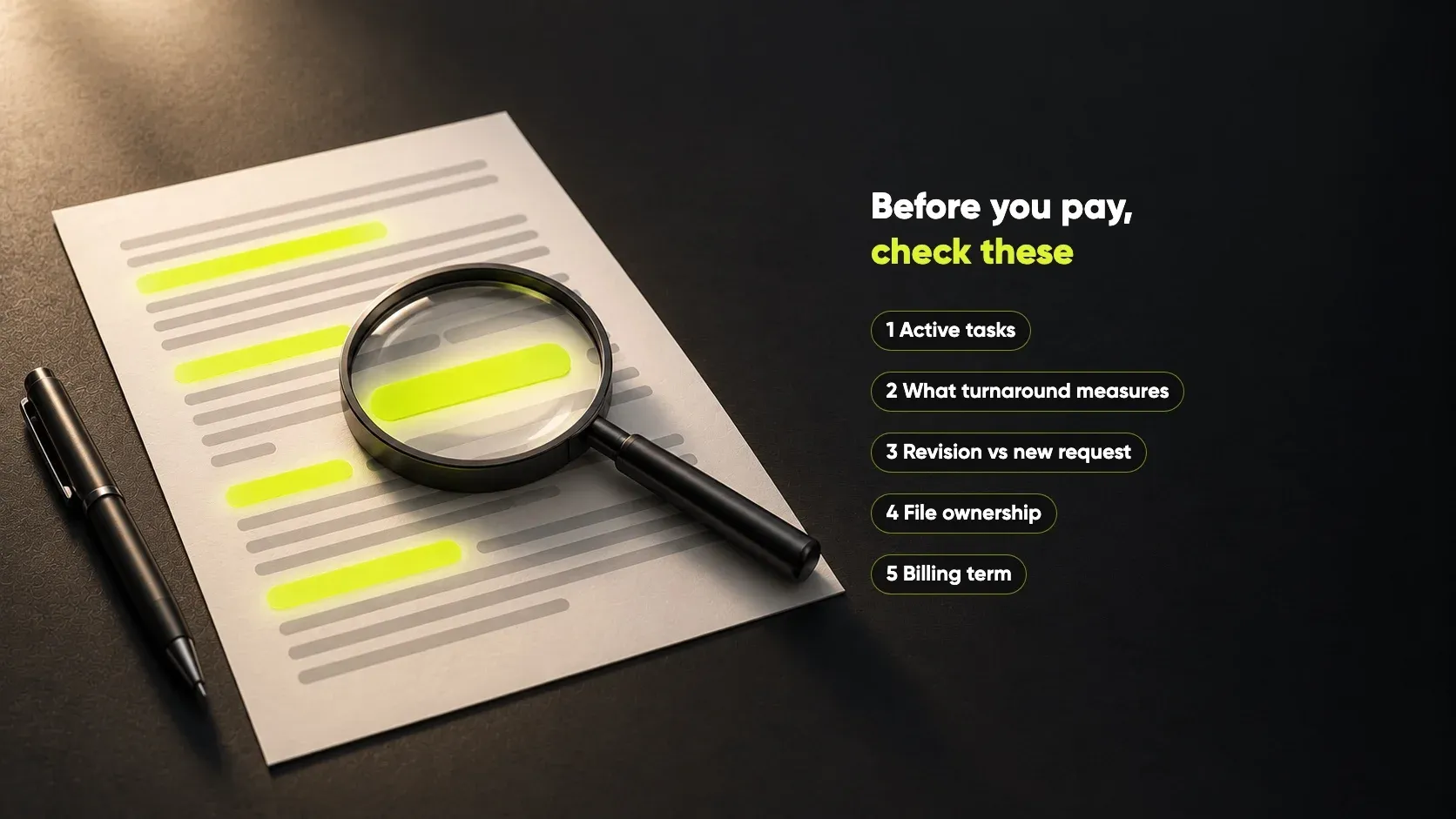
• Before you sign, check active tasks, what turnaround measures, what counts as a revision, who owns the files, the billing term and what costs extra.
What is an unlimited design subscription?
It is a flat monthly fee for ongoing design work from a team. Instead of quoting every job, you send requests through a platform or shared channel, and the team works through them: social posts, ads, decks, brand assets, landing pages and more. You know what design costs each month and you get a range of skills without hiring. The catch is in one word.
What "unlimited" really means
Unlimited requests, limited active tasks
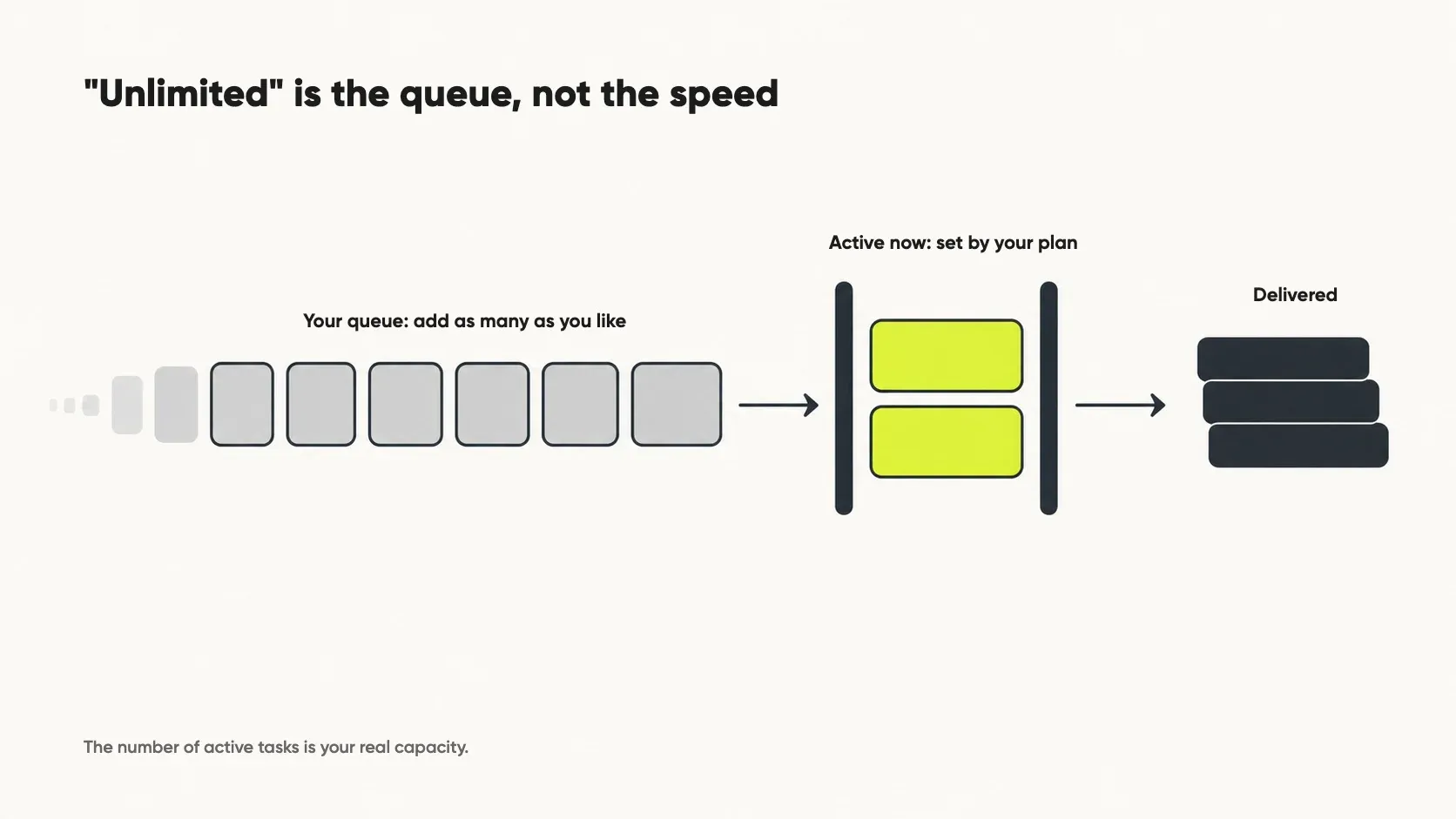
On most plans sold as unlimited, you can add as many requests as you like to a queue. The team works on one, two or a few at a time; when one finishes, the next starts.
Providers say this openly. ManyPixels' pricing FAQ explains that the practical ceiling is "your designer's daily output, not an arbitrary request cap". Penji's pricing page says you can queue as many projects as you want, while the team actively works on two at a time on its entry plan.
So the number that matters is the number of active tasks, and it usually goes up with the price of the plan.
Turnaround: first draft, not finished work
"Next-day delivery" and "24–48 hours" are real, but read what they describe. They usually mean a first draft of a small, clear request, counted in business days.
- ManyPixels says first drafts land next business day or same day, depending on plan, and that complex work such as full brand identities, long decks and websites takes several days on any plan.
- Penji says most projects deliver in one business day, while motion graphics or multi-page decks may take longer.
- Design Pickle's pricing page says most requests come back within one to two business days, depending on scope.
Revisions: unlimited within the brief
"Unlimited revisions" normally means the team refines a design until it matches what you asked for. It does not usually let you turn a social post into a full campaign. A change of direction or a new set of sizes is often a new request that joins the queue. Ask where your provider draws that line.
| The promise | What it usually means | What to ask |
|---|---|---|
| Unlimited requests | As many requests as you like in a queue, worked on a few at a time | How many tasks are active at once on this plan? |
| Next-day or 24–48 hour delivery | A first draft of a small task, in business days | How long do a brand identity, a 15-slide deck and a landing page take? |
| Unlimited revisions | Changes within the original brief | When does a change become a new request? |
| Dedicated designer | Varies: one named designer, a small team or a pool with a project manager | Will the same people work on my brand every month? |
| All design types | The services listed for your plan; some only on higher tiers | Is motion, video, web design or development on my plan? |
| Cancel anytime | Depends on the billing term and notice period | Is billing monthly, quarterly or annual, and how much notice do you need? |
Not every design subscription works the same way
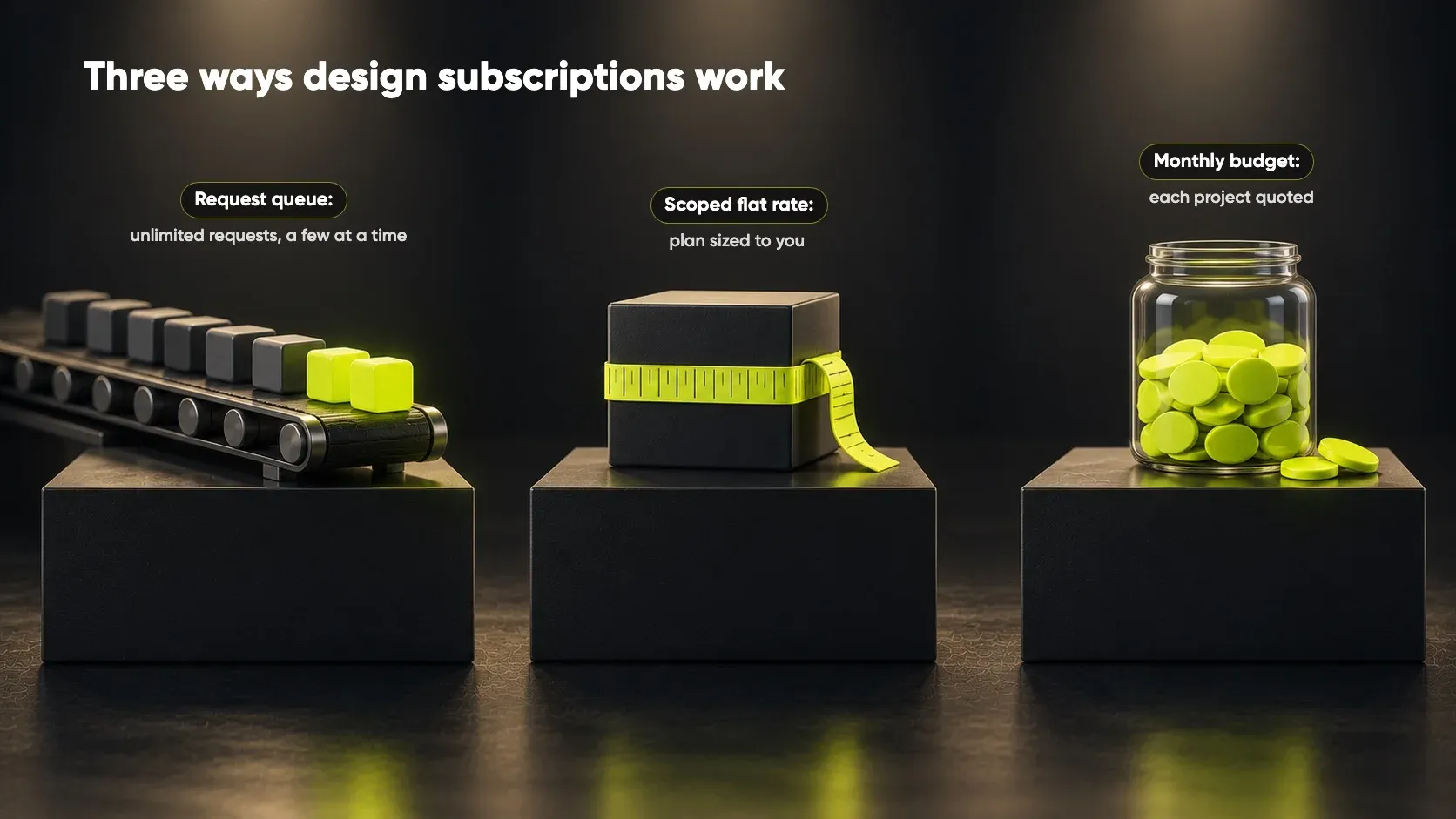
"Design subscription" covers three main models: a request queue (unlimited requests, a set number of active tasks), a scoped flat rate (a custom monthly price set for your volume and services) and a monthly budget (each project is quoted against it). Compare prices only within the same model.
Here is how four well-known providers describe their own plans on their public pricing pages, as checked in October 2026. Prices and terms change, so always check the live page.
| Provider | Model | Price shown (as of October 2026) | How capacity works | Term |
|---|---|---|---|---|
| ManyPixels | Request queue | From $699/month on monthly billing | Unlimited requests and revisions; plans set daily outputs or an assigned designer | Cancel anytime; pause option |
| Penji | Request queue | From $995/month | Unlimited queue; 2, 3 or 4 active projects by plan | No contracts; 30-day money-back guarantee |
| Design Pickle | Scoped flat rate | Set on a consultation call | Plan sized to your volume, turnaround and services; revisions included | Quarterly or annual billing |
| Superside | Monthly budget | $15,000/month minimum, plus a $1,000/month software fee | Each project is quoted against your budget; unused budget rolls over for up to three months | Annual commitment |
A queue suits a steady flow of smaller tasks and a known monthly price. A scoped rate suits teams that want a plan built around their volume. A budget suits large teams with big, varied campaigns.
What is usually included, and what usually is not
Every provider draws the line differently, so treat these as things to check, not rules.
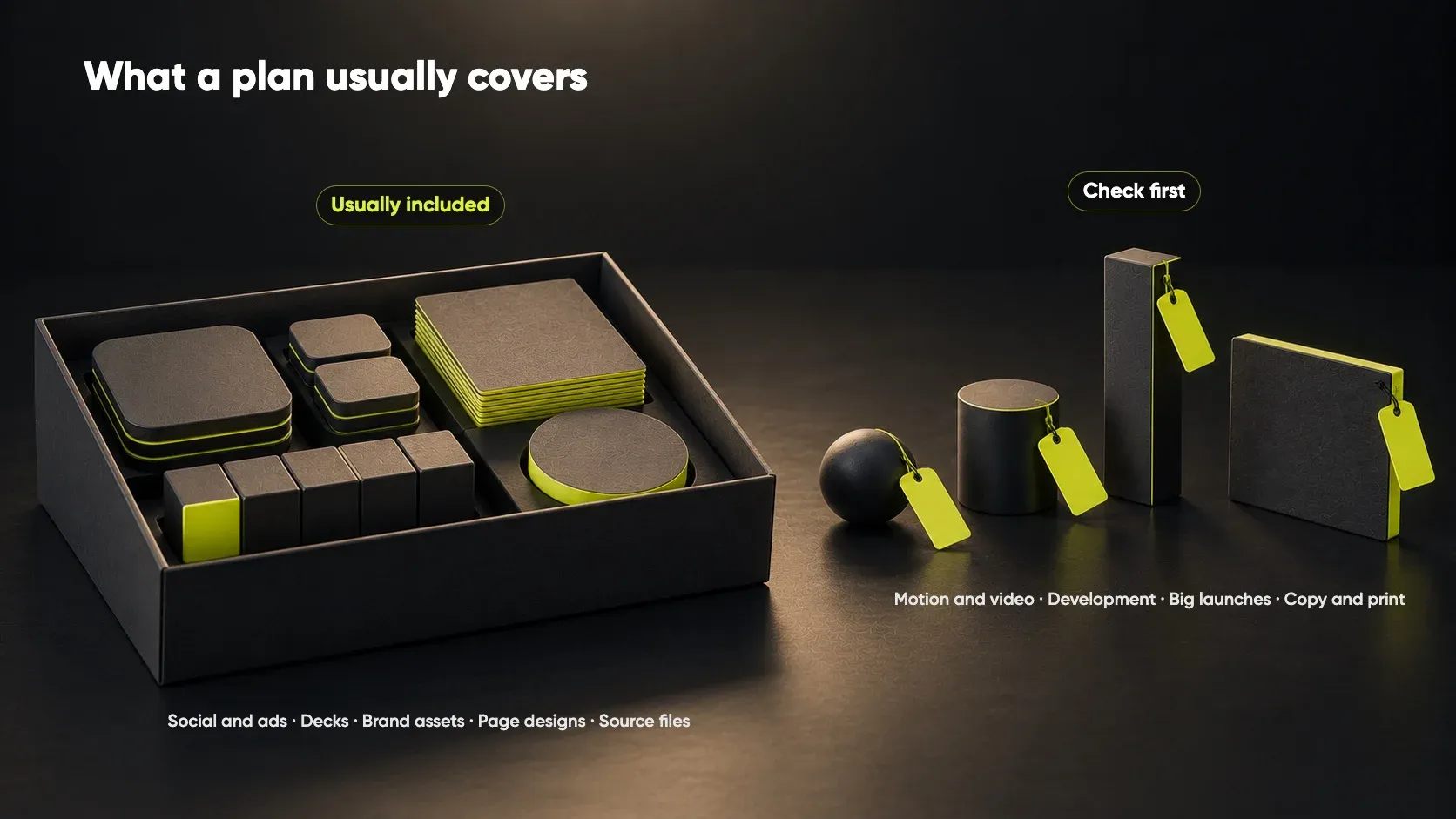
Usually included
- Everyday marketing design: social posts, ads, email graphics, banners and infographics
- Presentations and pitch decks
- Brand assets and templates, often logos and brand guides too
- Landing page and web page designs
- Editable source files, such as Figma or Adobe files, as well as exports
- A place to store your brand assets so every request starts from the same files
Often limited, on higher plans only, or extra
- Motion and video. Often on higher tiers only. Penji, for example, lists motion graphics and short-form video from its second plan up.
- Development. Most subscriptions design pages rather than build them. Penji lists front-end development only on its top plan.
- Large projects. A rebrand or big launch may sit outside the monthly flow. Superside sells separate "Project Boosters" for this.
- Copywriting, printing and media buying. Rarely part of a design plan.
- Art direction. On some plans you steer the work yourself; on others an art director or coordinator does it with you.
The real benefits, when the model fits
- A predictable cost. The same fee every month, with no hourly bills or surprise quotes.
- A range of skills. Brand, UI, decks and marketing design from one team.
- Speed to a first draft. Days, not a hiring process.
- Room for busy months. A launch spike waits a little longer in the queue, but the cost stays the same.
- Less key-person risk. Work does not stop when one person is away or leaves.
- Files in one place. Source files and brand assets stay organized, so new work starts from the right logo, fonts and colors.
If you are deciding between a subscription and a hire, our design subscription vs in-house designer post compares the full cost of each, side by side.
When it is not the right fit: you need one large project and then nothing (a fixed-scope project is simpler), you need a designer inside daily product decisions (often better in-house), or nobody on your side has time to brief and review. A subscription moves at the speed of your feedback.
How to judge any provider: 8 questions to ask before you pay
- How many tasks are active at once? This is your real capacity.
- What does turnaround measure? First draft or finished file, business or calendar days, and for which work?
- When does a revision become a new request? Ask for an example.
- Who will work on my brand? One named designer, a steady team, or whoever is free?
- Do I own the work and get source files? Editable files, not just exports.
- What is the billing term and notice period? Monthly, quarterly or annual?
- What is not on this plan? Motion, video, development, copy, stock, extra brands.
- Is there a trial, guarantee or short first term? It lowers the cost of finding out.
Then test it. In the first two weeks, send a mix: a few small requests, one medium piece such as a short deck, and one task that needs real brand understanding. Time each one, count the feedback rounds and notice the questions the team asks. A clear brief helps; our guide on how to write a brand brief shows what to include, and 6 mistakes companies make when outsourcing design covers the traps.
How DesignHQ plans work
DesignHQ is a request-queue subscription with the limits spelled out. On every plan you get unlimited requests and unlimited revisions. What changes between plans is how many projects are active at once:
| Plan | Price | Active projects | Also included |
|---|---|---|---|
| Starter | $1,500/month | 1 | Standard design types, email and chat support, brand asset storage |
| Professional | $2,500/month | 2 | Professional design types, priority support and a design coordinator, rush delivery available |
| Enterprise | $4,500/month | 3 | Enterprise design types, a dedicated account manager, unlimited rush delivery |
So the honest rule from this guide applies to us too: unlimited is the queue, and the number of active projects is the speed. You see first concepts within 48 hours, receive editable source files and keep your brand assets stored in one place. Plans are monthly, and you can switch or cancel anytime, with no notice period. Full details are on the pricing page.
Frequently asked questions
Is an unlimited design subscription really unlimited?
The number of requests usually is. The amount of work done at the same time is not: each plan works on a set number of tasks at once, and complex work takes days. Think of it as an unlimited queue with a fixed speed.
How many designs will I get each month?
There is no honest fixed number. It depends on the number of active tasks, how complex each request is and how quickly you give feedback. Small, clear requests move fastest; a full brand identity takes far longer than a social post.
Is a design subscription cheaper than hiring a designer?
For most growing companies with varied design needs, yes, once you add salary, benefits, tools and recruiting to the cost of a hire. See our full cost comparison.
What happens to my files if I cancel?
That depends on the provider's terms, so check before you sign. Ideally you own all finished work and its source files, and can download everything before your last billing period ends.
Want to see what a month with DesignHQ looks like?
DesignHQ has been designing for brands since 2016, has shipped 500+ projects and has worked with clients including Amazon, Accenture, Twilio, Intuit and Air India Express. Send a brief and you see first concepts within 48 hours. Plans start from $1,500/month, with unlimited requests and revisions, and you can cancel anytime.
Compare our plans or talk to us about what you need each month.