The Business Case for Outsourcing Design to India: Quality, Speed & Cost in 2026
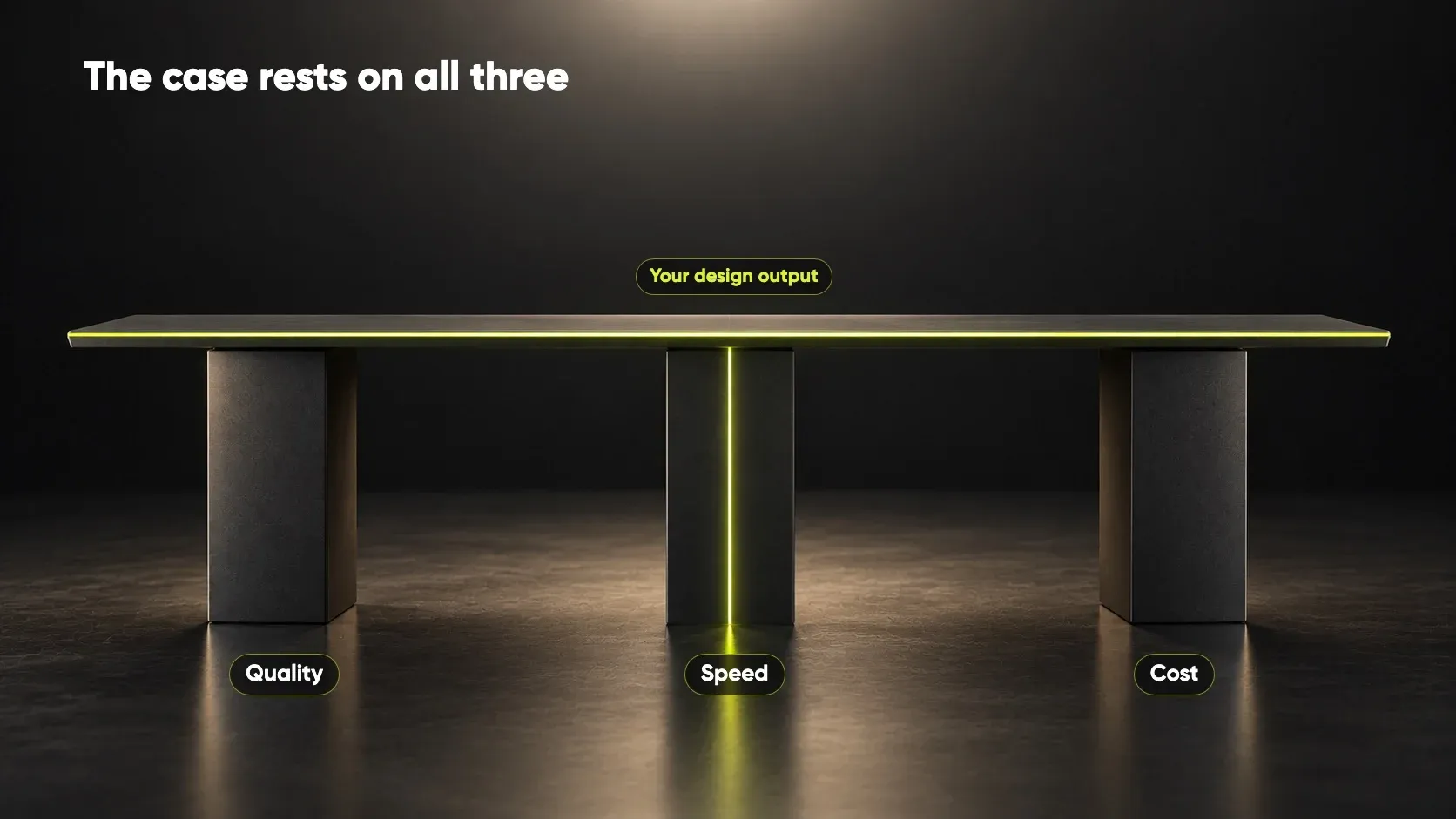
Most articles about outsourcing design to India start and end with price. Price matters, but on its own it is a weak reason to pick a partner: a cheap design that needs four rounds of fixes is not cheap. The stronger business case for outsourcing design to India in 2026 rests on three things working together: quality you can check before you commit, speed from the time difference, and a cost structure that lets you buy more experience for the same budget.
A quick note on bias: DesignHQ is an India-based studio, so we have a stake in this argument. We have linked our sources, and we are clear about where India is not the right answer.
Key takeaways
• The case for India is quality, speed and cost together, not cost alone.
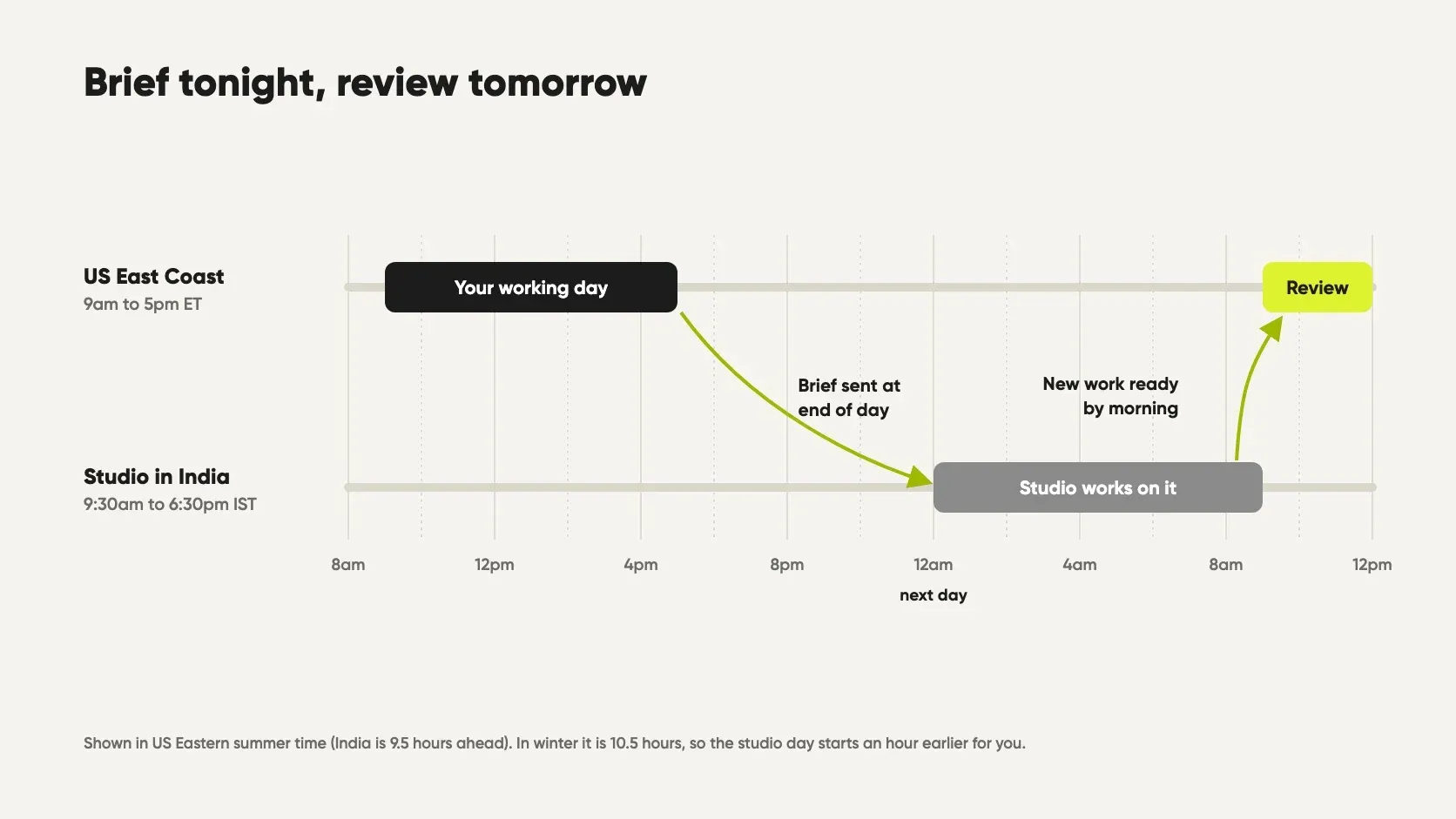
• The time difference is an advantage if you work asynchronously: brief at the end of your day, review new work the next morning.
• Design salaries in India are a fraction of US salaries, which is why studios can charge less. A studio fee is still more than a salary, because it pays for management, review and tools.
• Quality depends on the partner, your brief and your feedback process far more than on the country.
• The main risks (IP ownership, data, uneven quality, little live overlap with the US) can all be managed with a clear written contract and a short paid pilot.
Why India, and why now
India's design market did not appear overnight. The National Institute of Design was set up in Ahmedabad in 1961, and design education has grown a great deal since. Around it sits one of the world's largest technology services industries: Nasscom estimated India's tech workforce at 5.8 million people in FY2025, with US$224.4 billion in export revenue.
Most of those people are not designers, and we could not find a reliable published count of designers in India, so we will not quote one. The tech industry matters for a simpler reason: it built the habits remote client work depends on, such as written briefs, clear processes, shared tools and English as the everyday language of business with overseas clients.
Buying has also got simpler. Many Indian studios now sell design as a fixed monthly design subscription instead of hourly billing, so you buy an outcome and the provider handles hiring, review and cover.
If you are still deciding between countries, our comparison of India, Eastern Europe and the Philippines covers that choice. This post tests whether the business case for India holds up.
Quality: what you can actually expect
The quality of outsourced design is decided by three things that have nothing to do with geography:
- Who does the work and who checks it before you see it.
- The brief you give. A vague brief gets a vague first draft in any country.
- How feedback works. Clear, written, combined feedback means fewer rounds.
Where established Indian studios are usually strongest is breadth. One partner can often cover brand identity, UI/UX, websites, pitch decks, motion, packaging, social and ad creative. That matters more than it sounds: a single partner who already knows your brand saves you briefing five freelancers from scratch.
The honest limit is range. India has excellent studios and poor ones, sometimes side by side. You cannot judge a partner by the country, so judge them directly:
- Look for work in your category, not just a pretty portfolio.
- Ask who will work on your account, and who reviews their work before it reaches you.
- Ask for editable source files as standard, not as an extra.
- Run a small paid test before you sign anything long.
Speed: turning the time difference into a head start
India Standard Time is UTC+5:30 and India does not change its clocks, so the gap with you shifts when your country moves to or from daylight saving. Check exact hours with a time zone converter.
| Your team | Time difference to India | What a working day looks like |
|---|---|---|
| US East Coast | India is 9.5 to 10.5 hours ahead | Brief at the end of your day; new work is usually waiting the next morning |
| US West Coast | India is 12.5 to 13.5 hours ahead | Almost no shared hours; fully asynchronous works best |
| UK | India is 4.5 to 5.5 hours ahead | Your morning overlaps the Indian afternoon, so live calls are easy before lunch |
| Australia (Sydney) | India is 4.5 to 5.5 hours behind | The Indian morning is your afternoon, with a few shared hours each day |
For US teams this is the core of the speed case: your day ends, the studio's begins, and the work happens while you sleep. You review in the morning, send feedback before lunch, and the next version is ready the following day.
It only works if two things are true:
- The brief can stand on its own. If the designer has to wait a day to ask a question, you lose the advantage. Our guide on how to write a brand brief shows what to include.
- There is a set window for questions. Even 30 minutes of shared time, or a short recorded video in each direction, keeps work moving.
There is a second speed gain: no hiring cycle. A managed studio can start in days and take on more in a busy month without you recruiting anyone. At DesignHQ, for example, you see first concepts within 48 hours of a brief. Be realistic, though: "overnight" applies to the next round of a task, not a whole project. A brand identity still takes weeks, wherever it is made.
Cost: where the savings come from, and where they don't
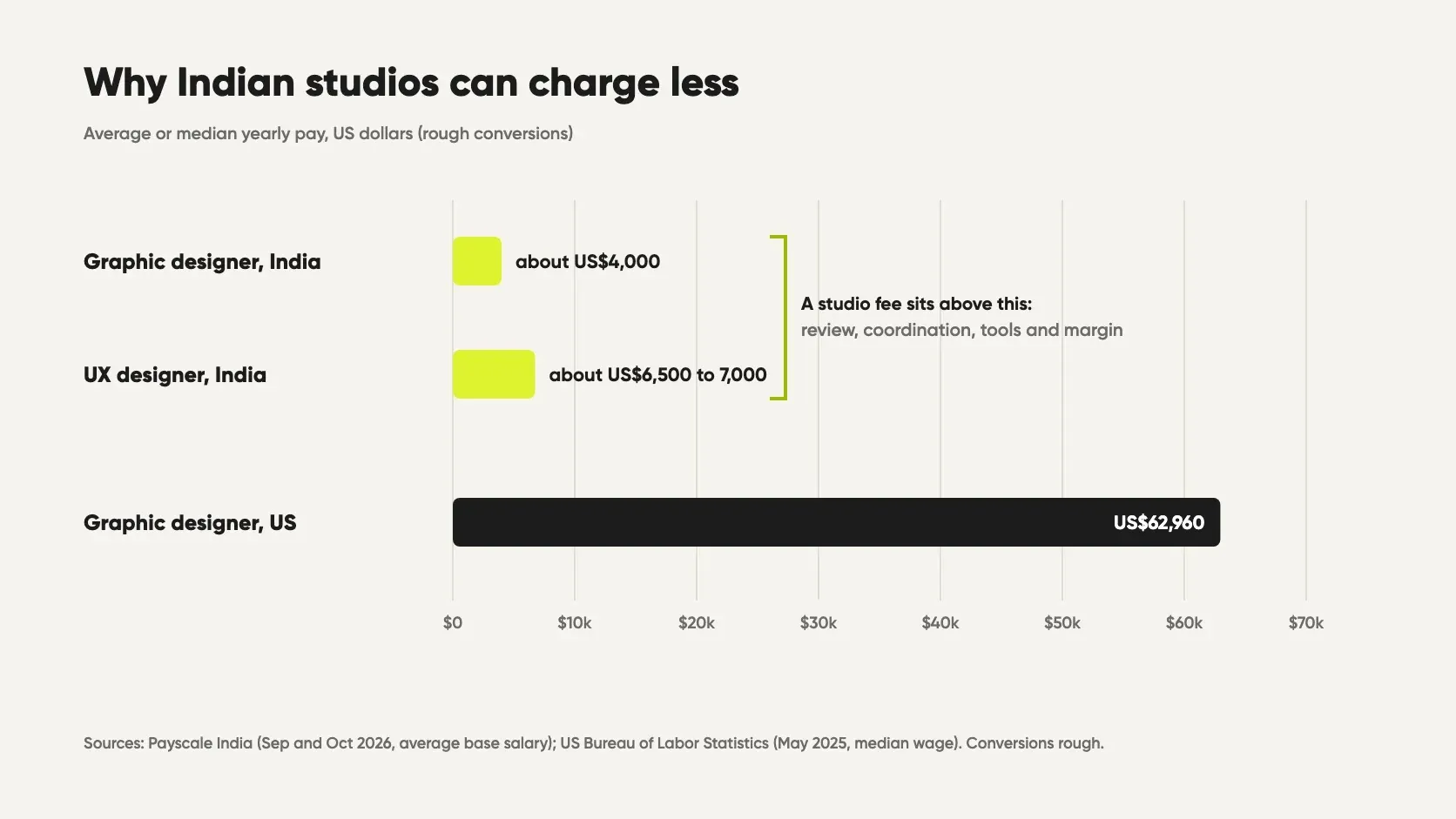
The cost gap starts with salaries. These are the most recent figures we could check:
| Role | Pay | Source |
|---|---|---|
| Graphic designer, India | ₹369,327 average base salary a year (roughly US$4,000) | Payscale, updated October 2026 |
| UX designer, India | ₹625,841 average base salary a year (roughly US$6,500 to US$7,000) | Payscale, updated September 2026 |
| Graphic designer, United States | US$62,960 median annual wage | US Bureau of Labor Statistics, May 2025 |
The sources measure pay differently (Payscale uses self-reported salaries, the BLS surveys employers) and the dollar conversions are rough, so read this as the size of the gap, not a price list.
Here is what most "save 70%" claims leave out: you will not pay an Indian salary. A studio's fee also covers senior review, coordination, software, cover for leave, and its margin. The saving is real, but smaller than the salary gap suggests, so compare the full cost of each option for the same output.
There are three common ways to buy design from India:
- Freelancers. Usually the lowest hourly price, but you do the hiring, reviewing and chasing. Our country comparison gives indicative hourly ranges.
- A dedicated hire through an agency or employer-of-record service. One person full time, but you manage their work and cover their absences.
- A managed studio or design subscription. A flat monthly fee for a team that is managed for you. DesignHQ plans, for example, are $1,500/month (Starter, one active project), $2,500/month (Professional, two active projects with a design coordinator) and $4,500/month (Enterprise, three active projects with a dedicated account manager).
To compare any of these with a local hire, count everything an employee really costs: salary, benefits, tools, recruitment and management time. We break that down in design subscription vs in-house designer.
Also budget for costs on your side: time spent on briefs and feedback, extra rounds from unclear briefs, payment fees, and switching if a partner does not work out.
How to manage the risks
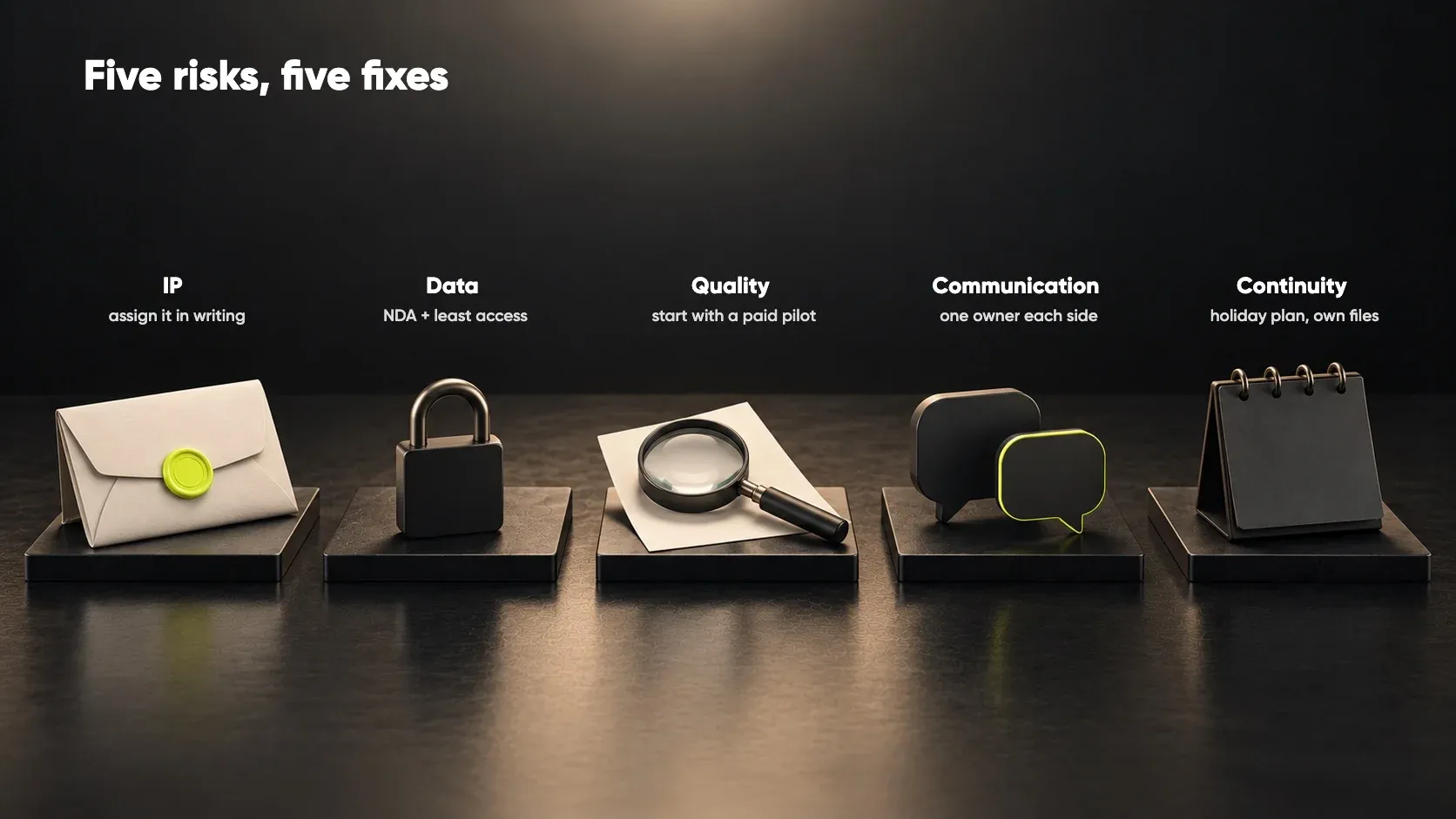
None of these risks is unusual, and each has a simple fix if you deal with it before work starts.
Intellectual property
Paying for work does not by itself make it yours. Under India's Copyright Act, an assignment of copyright must be in writing and signed. If the contract does not state how long the assignment lasts, it is treated as five years; if it does not state the territory, it is presumed to cover India only. So your contract should assign all designs and source files to you, worldwide, for the full term of copyright, on payment. This is general information, not legal advice; have a lawyer check your contract.
Data and confidentiality
Sign an NDA and share only the files and systems the studio needs. India's Digital Personal Data Protection Act, 2023 now has rules in place: the government notified them in November 2025, with an 18-month phased rollout. Your own data obligations still apply, so use dummy data in designs where you can, and a data processing agreement where you cannot.
Uneven quality
Run a paid pilot, agree who works on your account, and ask what happens if a designer leaves. Our post on the 6 mistakes companies make when outsourcing design covers the most common traps.
Communication
Name one owner on each side, keep every request in one place, give written feedback with examples, and agree a turnaround time for each type of work. A short weekly call covers the rest.
Continuity and lock-in
Ask for the studio's holiday calendar early, especially around major festivals such as Diwali, and how they cover leave. Keep brand assets and source files in storage you control, and prefer monthly terms until a partner has earned your trust.
When India is not the right choice
A fair business case includes the cases where it does not hold:
- A product designer who sits in your daily stand-ups and user research is usually best hired in-house or in a close time zone.
- UK and EU teams who need the whole working day together may be better served by a partner nearer home. See our country comparison.
- Data that cannot leave your country under your rules or your clients' contracts.
- A single small job, where setting up any new partner is more effort than it saves.
For most other design work, the case is strong if the process is right.
Test the business case in 30 days
You do not have to take anyone's word for it, including ours. Test it on real work:
- Week 1: pick a contained project, such as a landing page, a pitch deck or a set of ads, and write a proper brief.
- Week 2: brief one or two partners. Good questions back are an early sign of quality.
- Week 3: give feedback as you would on a normal project, and track how quickly and how well each round comes back.
- Week 4: compare time to first concept, number of rounds, hours your team spent, and whether the result is good enough to ship.
If those numbers beat your current setup, the case is proven for your company, which is the only proof that counts.
Frequently asked questions
Is outsourcing design to India cheaper than hiring in-house?
Usually, for the same work, because Indian design salaries are much lower. Compare full costs, though: a studio fee includes management and review; an in-house hire adds benefits, tools and recruitment.
How do you handle the time difference?
Work asynchronously: brief at the end of your day, review in the morning, and keep a short shared window for questions.
Who owns designs made by an Indian studio?
Whoever the signed contract says. Spell out worldwide rights for the full term of copyright, plus source files, because Indian law limits an assignment with no stated territory or term.
What design work outsources best to India?
Brand, marketing and social creative, websites, product UI, presentations, packaging and motion. Embedded product design that needs daily live collaboration is better kept close.
Want to test the case on a real project?
DesignHQ has worked with clients including Amazon, Accenture, Twilio, Intuit and Air India Express, and has shipped 500+ projects since 2016. Send a brief and you see first concepts within 48 hours. Every plan includes unlimited requests and revisions and editable source files, plans start from $1,500/month, and you can cancel anytime.
See our plans or get in touch to talk through a pilot project.